

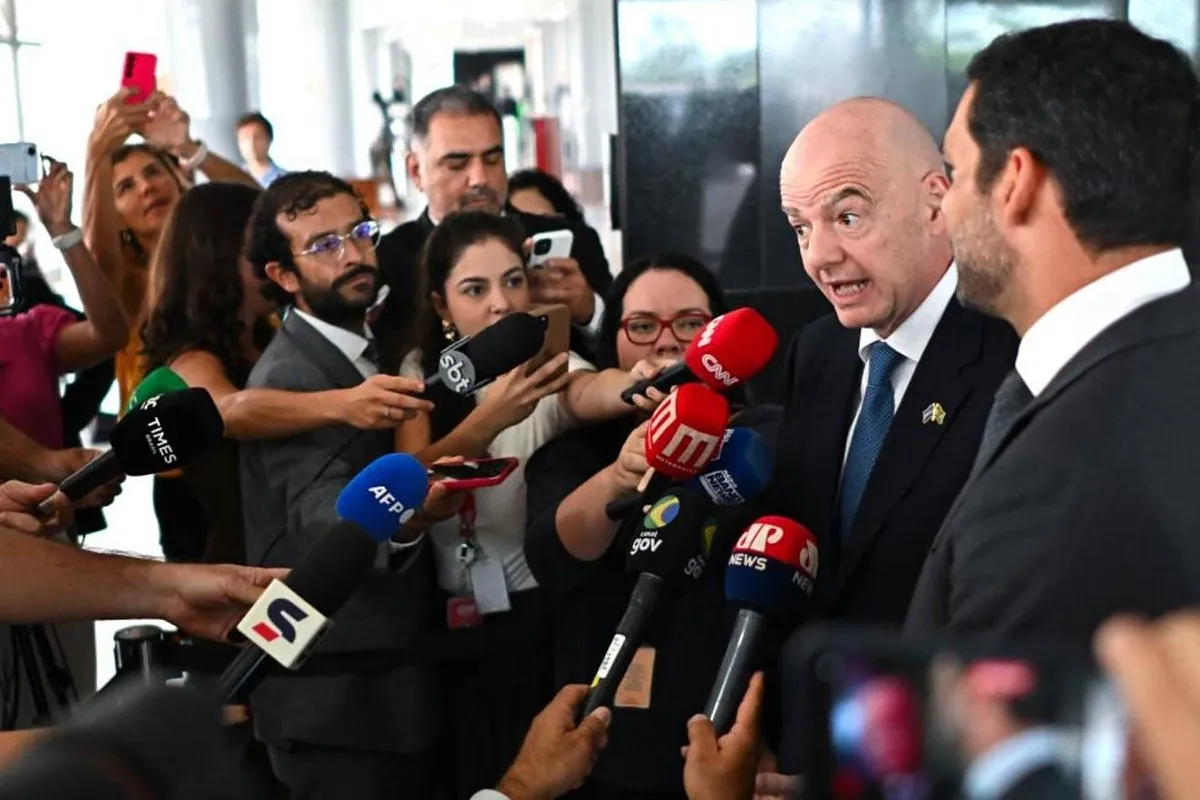
GFIFA president Yianni Infantino said the efforts had not yielded any results and Russia’s ban on international competitions needed to be lifted. Teams from Russia and Belarus, and their national teams, were banned from participating in international competitions following the invasion of Ukraine in early 2022.“It’s definitely something we have to do, at least for the young people,” Infantino told Britain’s Sky on Monday. “This ban has achieved nothing and has only created more frustration and hatred. It would help if Russian boys and girls could play soccer in other parts of Europe.”
Infantino also described Israel’s possible veto over the Palestinian massacres as a “defeat.” “The law should clearly state that no country can be banned from playing soccer because of the actions of its political leaders,” he said.In the same interview, the FIFA president also defended the organization’s decision to award former US President Donald Trump with the newly created Peace Prize. “Objectively, he deserves it. I’m not the only one who says that, so do the Nobel Peace Prize laureates, and I’m talking about Maria Colina Machado. He has helped resolve conflicts and saved thousands of lives,” he said.
World Cup forever girlfriend Larissa Riquelme reappears on the beaches of Paraguay
UEFA and FIFA ideas that didn’t materialize
FIFA has already adopted fundamental decisions in this regard at its 2023 Council meeting. Following the UEFA Executive Committee’s previous decision to allow both the women’s and men’s Russian U-17 national teams to return to UEFA competitions, the FIFA Council has approved the extension of this resolution to the FIFA U-17 World Cup(TM) and FIFA U-17 Women’s World Cup(TM), thus lifting the ban on these Russian teams.
Several months later, after failing to find a technical solution, UEFA suspended the Russian U-17 team from re-entering the competition, following a decision of its executive committee in September. The initiative angered Ukraine and several other countries’ soccer federations, including England, Poland, Latvia, Lithuania, Sweden, Denmark, Finland, Ireland, Norway and Romania, which called for them not to play against the Russian team.
