

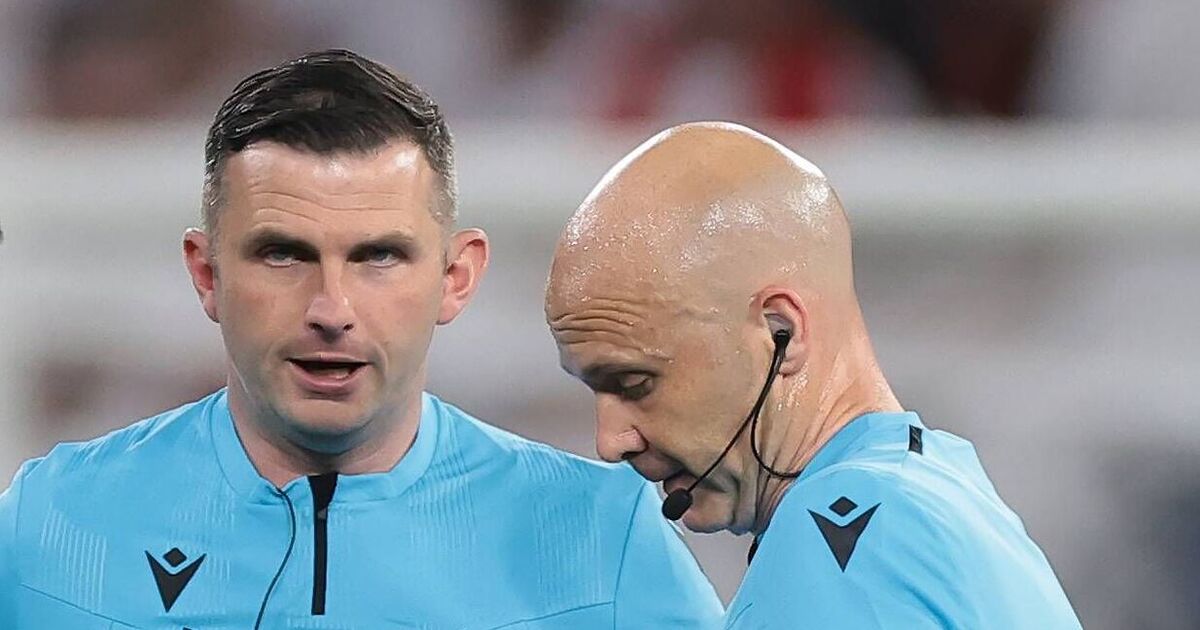
FIFA has confirmed that British referees Anthony Taylor and Michael Oliver have been banned from officiating Argentina matches at this year’s World Cup because of the Falklands War 44 years ago. Naturally, many factors are taken into account when appointing match officials, but the most important is the overall performance of the referee, working alongside the two assistant referees.
This fundamental aspect forms part of an ongoing evaluation process overseen by the FIFA Referees Committee, chaired by former World Cup finals official Pierluigi Collina. Obviously, referees cannot be in charge of their own country’s matches, nor can they be assigned to matches that directly affect their own country’s matches in a competition. For example, neither Oliver nor Taylor would be allowed to officiate group stage matches in England’s Group L, even if the Three Lions matches, such as Ghana vs. Panama, were not played.
Furthermore, if Thomas Tuchel’s England advance, an English referee will not be able to referee this weekend’s match between Argentina and Switzerland, as his decision could have a direct impact on potential semi-final opponents England. However, this provision does not apply to subsequent rounds of play. This explains why an all-Argentine refereeing team was allowed to oversee France’s 2-0 quarter-final victory over Morocco, despite Argentina being potential opponents in the final.
However, additional geopolitical considerations are taken into account when officials are assigned to matches. FIFA is understandably aware of the politically sensitive situation and has chosen to adopt pragmatism when selecting referees. One official characterized the process as “very fluid” with no strict rules imposed on the procedure.
Nevertheless, a FIFA spokesperson confirmed that the 1982 Falklands War is taken into account when appointing referees. Therefore, England officials are not allowed to supervise Argentina matches or matches that have a direct impact on Argentina’s next match, and vice versa.
The Mirror reported in 2022 that Argentina’s participation would prevent Taylor and Oliver from refereeing the 2022 World Cup final, and that this situation is likely to be repeated in this summer’s tournament, given that England and Argentina are tied and occupy the same half.
Although conflicts as remote as World War II are not considered, the Falklands War is still considered a politically sensitive subject. The war was also mentioned by Argentina’s players, who sang a song called “Muchachos” in the locker room after their quarterfinal victory over Egypt.
Despite FIFA’s strict rules against political expression inside stadiums, Argentina is not expected to face any disciplinary action for singing the song. As the 2026 World Cup moves into its final stages, referee selection is likely to become more rigorous. However, FIFA has made it abundantly clear that Taylor and Oliver will be excluded from officiating the Argentina match.
