

You’ve probably already seen this clip.
In the 79th minute of the World Cup last 16 match between Brazil and Norway, the score was 0-0, but Erling Haaland didn’t seem interested. Even casually. He wanders around outside the penalty area with his head bowed – the very image of a lonely No.9.
Brazil has him where they want…or so they think. Pivoting midfielders Casemiro and Danilo formed a loose box around the Manchester City striker, with Marquinhos and Gabriel playing comfortably in defensive shape.
A deliberate ploy to “play dead.” Looks like Messi. Nature’s ultimate predator is Erling Haaland. There are lots of memes to choose from.
Then, out of nowhere, a shock hit me. Andreas Schjelderup slips past Endrick on the left and Haaland makes a move. One of his trademark runs ran in behind Gabriel before finishing over Gabriel’s left shoulder, giving his country a 1-0 lead and en route to their first-ever World Cup quarter-final.
Gabriel is humbled. On the floor, face down. The moment you lose concentration, the game is over.
Haaland takes just a second to make a devastating impact. Defenders across Europe have learned that lesson well since he rose to fame at Borussia Dortmund, but stopping him is another matter entirely.

Erling Haaland’s overall performance per 90 in the Premier League – accumulating an incredibly high xG (expected goals) with his movements and converting it with deadly finishes (Image: Opta)
Planning how to deal with dangerous players will be at the top of manager Thomas Tuchel’s priority list as England prepare to face Norway on Saturday night.
We looked at three extremely rare cases in which Haaland failed to make an impact on the biggest stage to see if we can find any clues as to how the England manager will structure his defense to contain the most deadly pure No. 9 on the planet.
Manchester City 0-0 Arsenal (Premier League) – March 31, 2024
City were involved in a three-way title battle with Arsenal and Liverpool, who had just drawn 1-1 at Anfield. They faced the Gunners at the Etihad in a huge Premier League game.
The game ended 0-0 and Haaland had a near full house. Despite taking four shots, none of them hit the target and two of them were blocked, resulting in an xG of 0.31.
In terms of underlying numbers, this isn’t necessarily bad per se, but it’s a far cry from his own average of 0.9 xG per 90 games in the Premier League.
One of Haaland’s best attributes was his movement, with the Norwegian doing his best to avoid being surrounded by constant drifting between Ben White and William Saliba on the left, or Gabriel Magalhães and Jakub Kivioglu on the right.
Saliba and Gabriel defended wisely. Rather than man-marking Haaland, the two were able to stay close together and take away space for Haaland in Arsenal’s compact defensive structure.
When Haaland was wedged between Arsenal’s two centre-backs, he tried to use his force to separate them. Anticipating a late cross, he tried to drop to Saliba to create more space, but Arsenal often cut off passes to him.
This Arsenal backline was made up of all four giants, but England will struggle to replicate that with Jarrell Quansah suspended. Jarrell Quansah could be used again at right-back.
However, if the full-backs can also keep compact and switch on, a strong defensive partnership can take away space from Haaland.
Manchester United 2-0 Manchester City (Premier League) – January 17, 2026
Despite United’s rotating centre-half pairing over the last few seasons, Haaland hasn’t always scored in derbies.
City’s strikers have the intelligence to avoid big defenders in the air like Harry Maguire, so they tend to position themselves at the back post to try to overwhelm the full-backs, or in United’s case the diminutive Lisandro Martinez.
However, Haaland did not hold his nose in this match. The Norwegian, who came on as a substitute in the 80th minute, managed to accumulate just 0.13 xG with two shots, both of which were blocked, and his only aerial duel was not won.
This was largely a result of Martinez’s smart, aggressive defensive style. Considering his own height disadvantage, Martinez followed his own blueprint of dealing with Haaland on the front foot, staying in front of Haaland to make first contact on every ball coming his way, and coming forward to stop Haaland from turning and darting into space in transition moments to protect Haaland.
It’s a risky approach, but Martinez has consistently approached Haaland this way over several matches, including the 2024 FA Cup final and the Etihad derby in December 2024, both of which United won with Haaland blank.
Midfielder Casemiro also concentrated on cutting off passing lanes to Haaland from off the ball, rather than trying to stop City’s dangerous creator directly at the source.
Could this be England’s blueprint for a smaller, faster, more agile Guehi Andersson?
Crystal Palace 1-0 Manchester City (FA Cup Final) – 17 May 2025
As Crystal Palace lifted their first major trophy, Haaland was restricted to just three shots, one on target and none between the posts, but had an xG of 0.24.
Facing a solid back three of Chris Richards, Maxence Lacroix and Marc Guech, Haaland surprisingly targeted Richards rather than the shorter Guech, but to no avail.
Haaland made a trademark last-minute move towards the back post after slipping in behind Richards early in the game when he thought he had covered a cross, forcing a sharp save from Dean Henderson after he failed to get the shot he needed from the Norwegian’s left boot on a stretch volley.
Richards noticed this right away. In the second half, he made an important intervention, twice observing Haaland’s position, this time anticipating Haaland’s dive in behind and clearing the ball before it reached the big man.
Palace’s compact defensive structure enabled them to secure a narrow victory, but it was a victory that relied heavily on Henderson’s heroics and last-ditch defense to win the cup.
So while some luck may be required, predictions will be crucial for players unlucky enough to mark Erling Haaland.
Who should start in England’s defense?
Rewatching Tuchel’s ‘Dan Byrne master plan’ against Mexico – six clearances, including two headers that crossed the halfway line as a 75th minute substitute – the easy conclusion would be to pit the English giants against the Norwegian giants.
However, this was a reaction to Tuchel’s particular game plan of England going down to 10 men and defending crosses to protect the lead.
Quansah’s suspension could not have come at a worse time for England.
Haaland’s movement is biased towards the left side of Norway’s six-yard box, with Alexander Soros drifting in from the right and using his large size to threaten the defense.
This means that the player who starts at right-back will also need to pay close attention to Haaland’s movements to avoid being isolated in defense at the back post.
However, if we look more closely at Haaland’s performance against England’s current options in the middle, some conclusions can be drawn.

Erling Haaland’s individual performance as a center back for the England national team in the quarter-finals against the Premier League (excluding John Stones) (Image: Opta)
Despite having played the least amount of time with Haaland in the Premier League, he has been the happiest with a defense that includes Guehi, scoring seven goals in just four games against his current club team-mates.
He also accumulated a higher xG (4.3) against Guehi than against England’s other options.
In contrast, Ezri Konsa and Dan Byrne have the best team record without Haaland, with the City striker having scored just one goal in the five games before the game against Konsa and just one goal in the six games against Byrne.
Of England’s current options, only Byrne has played more minutes in the Premier League against Haaland than Konsa, but Konsa has far fewer shots per 90 against Villa (2.2) than Burn against Newcastle (3.5).
A closer look at Haaland’s interactions with England’s centre-backs may reveal some surprising results.

Erling Haaland’s Premier League performance against England’s centre-back options in the quarter-finals (excluding John Stones) (Image: Opta)
Byrne has contested almost three times as many duels as Haaland (15) among his English colleagues, but has won only six of them (40%) and conceded more fouls in the process (three) than any other player.
In the air, Byrne had the second worst win percentage against Haaland among England’s options, winning five of the ten aerial duels against the Norwegian.
Despite being the shorter centre-backs among the four, Konsa and Guehi have won 75% and 66% of their aerial duels with Haaland, respectively, and their overall duel win rates are 66% (Konsa) and 83% (Guehi).
Impressively, Guehi has never conceded a foul against Haaland in the Premier League and even won against Haaland with three fouls.
Chalobah’s performance was by far his worst, winning only 25% of his aerial duels with Haaland and 33% overall.
Of course, the only player with the strongest argument to start as a concrete measure against Haaland, John Stones, does not appear in the data as he has never faced Haaland on the pitch.
Stones is actually an incredible aerial defender, winning 84.6% of his aerial duels in the minimal amount of time he played in the Premier League last season.

Machine Football Player Score rates John Stones as a better defensive header than Dan Byrne. This may come as a surprise to some, but his impressive duel numbers back it up (Image: Machine Football)
Stones also has the advantage of having trained alongside and opposite Haaland throughout his City career, making him more familiar with the striker’s subtle movements than any other centre-back in the squad.
Will Dan Byrne’s master plan be revived?

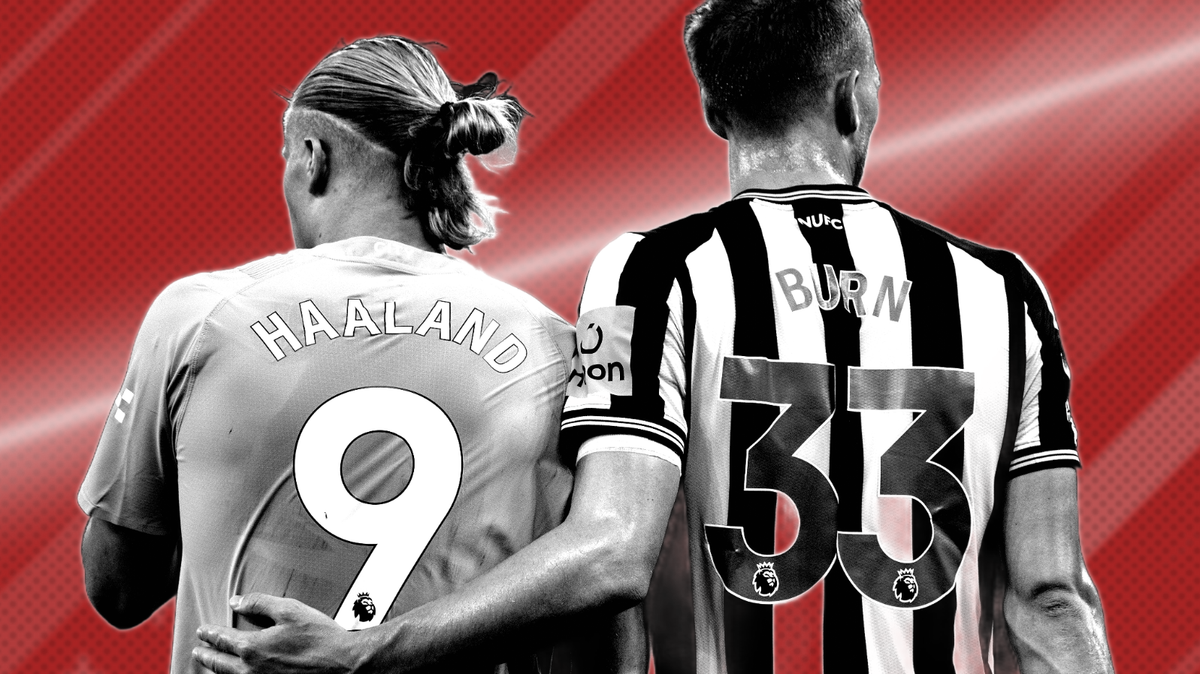
Erling Haaland and defender Dan Byrne clash (Image: Getty)
Looking at the stats above, it’s hard to argue that Byrne should start as a means of containing Haaland. Although his man-marking has ruffled Haaland’s feathers at Newcastle in the past, Byrne is a much better penalty box defender than a player capable of providing reliable screens for England’s front-foot approach.
If England are winning by a narrow margin late in the game, bringing on Byrne may be what is needed to dislodge Haaland, but Thomas Tuchel’s best bet from the outset would be to ensure there is a strong mutual understanding between the centre-backs and that at least one of them can face Haaland in the air.
So don’t be surprised if Stones gets a new starting spot, as he could potentially start alongside Konsa, who could face the Citizens’ top scorer in the defensive reshuffle from Tuchel.
If Byrne does start, he is likely to be used at left-back, allowing him to chase down the giant’s Soros in the penalty area. If that happens, England’s right-back identity could be key to supporting the right-sided centre-back in defense against Haaland.
Will Jed Spence’s speed be another weapon against Haaland? The Norwegian achieved a top speed of 31.52 km/h at the World Cup, making him the fastest player on the Norwegian national team. However, Spence has proven his speed with a top speed of 33.31km/h, and the pace of his recovery could be crucial.
Regardless of Tuchel’s decision, the battle between Norway’s goal machine and England’s backline will likely decide this big draw.

Join our new WhatsApp community and receive Mirror Football content every day. Community members also receive special offers, promotions, and advertisements from us and our partners. If you don’t like our community, you can check it out whenever you like. If you are interested, please read our privacy notice.
