

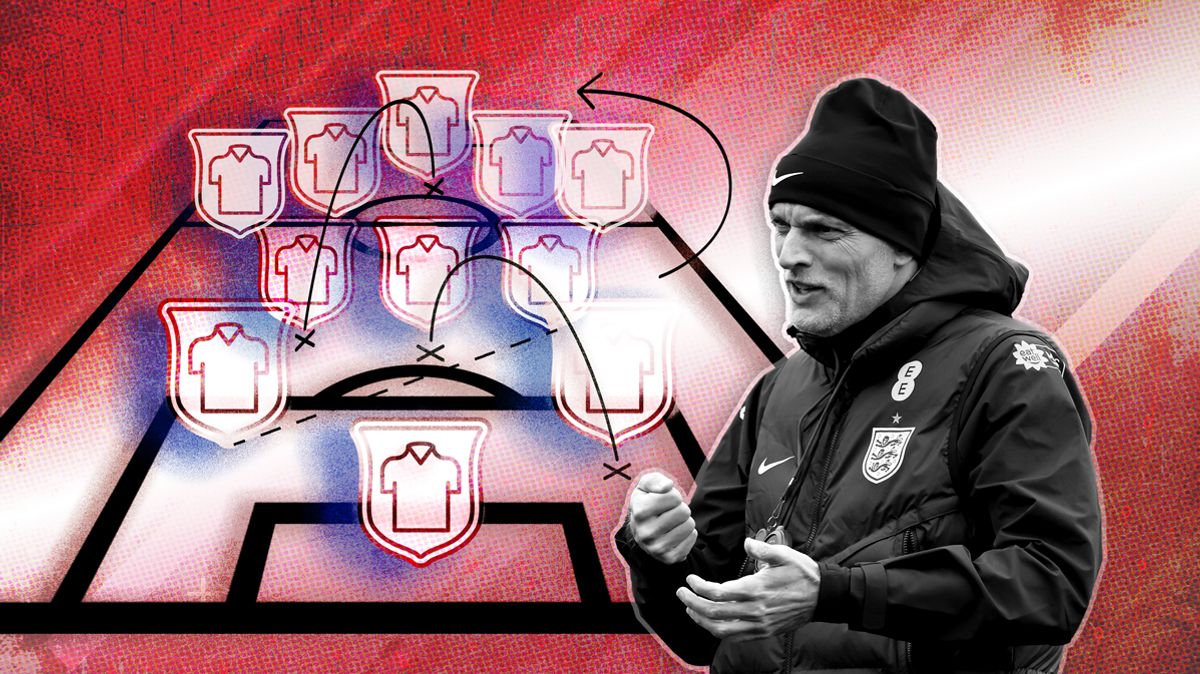
Thomas Tuchel’s tactics… This phrase has a nice alliteration.
And we have another chance to put the England head coach’s choices and style on the chin for a large squad of 35, split into two friendlies against Uruguay and Japan.
We will try to make it as easy as possible to understand Tuchel’s gigantic soccer brain using simple diagrams and explanations. If you get stuck, a handy glossary is just a click away.
Let’s get started:
Join us on Facebook! For the latest news, analysis and more on our Mirror Football Facebook page
1. Tuchel’s ‘attack engine’ style
We all still enjoy speculating on Tuchel’s best XI. Here’s our expert opinion and your chance to pick your XI. England correspondent John Cross previously identified six ‘Tuchel untouchables’: Jordan Pickford, Mark Guehi, Declan Rice, Bukayo Saka, Jude Bellingham and Harry Kane.
In the second half of this article, after digesting five key graphics, Cross will be fighting for a place in England’s World Cup opener against Croatia on June 17th.
He will then face off against former England and Premier League defender Graham Le Saux, who, as the founder of supercomputer machine football, has chosen England’s XI based on data.

(Image: Machine Football)
Machine Football, along with Premier League teams such as Arsenal, Manchester City and Chelsea, have developed a model that divides the approaches of different teams into eight main styles of play, placing Tuchel’s approach firmly within the same ‘attacking engine’ style.

(Image: Machine Football)

(Image: Machine Football)
If you’re a tactical geek and want to learn more about the definitions of these eight different styles, click here.
read more: World Cup glossary of buzzwords related to soccer tactics, data, and statistics
2. Tuchel just plays this way – there’s no going back!

(Image: Machine Football)
This diagram shows that Tuchel has played with the same style every time he has coached a title-winning club.
Indeed, Tuchel’s ‘attacking engine’ approach requires technical players, especially in the wide areas.
Tuchel’s side prefer to feed direct passes through the lines to talented attackers who can isolate defenders with one-on-one dribbles.
3. He likes set pieces, but is not good at long balls.

(Image: Machine Football)
Much has been written about the Premier League’s obsession with set-pieces this season, with Tuchel leaning into that trend with specialists Rice and Saka set to start and giants Dan Byrne and Harry Maguire competing for the centre-back spot.
However, if you look at the graph above as a snapshot of Tuchel’s Dortmund style, you can see that both of his teams are focused on:
Short, complex passes to separate the defending team High chance creation – An average of 14.6 shots per 90 minutes Sharp through passes from creative midfielders (e.g. Elliott Anderson) – An average of 14.9 shots per 90 minutes – Possession of the ball – Shown by low interceptions and blocks
Declan Rice provides the energy and tempo that Tuchel likes, while Elliott Anderson brings the creativity. The 23-year-old is one of only two English ‘playmaking six’ (along with Curtis Jones) in Europe’s top five leagues and has averaged just under 10 progressive passes per 90 minutes for Forest this season.
4. ‘Direct and attacking’ – Why Rashford is Tuchel’s favorite
England therefore need an attacking, direct wide player who can play well in transition, like Barcelona’s Marcus Rashford.

(Image: Machine Football)
Throughout his career, Tuchel has consistently been drawn to a certain type of wide player: Ousmane Dembele, Angel Di Maria and Leroy Sane. It is classified as a “Dynamic 7” in the Machine Football model. These players are progressive, direct and good in transition. Rashford fits that profile. Anthony Gordon isn’t.
Machine Football sees Gordon, Rashford’s direct rival for the wide-left starting spot, as an ‘incisive seven’ rather than a ‘dynamic seven’, meaning Gordon prefers to drift centrally and create central overload.
This is very useful when you have a centre-forward who drops deep to take part in the build-up, freeing up space for wide players like Roberto Firmino, Nick Woltemade or even Harry Kane.
However, Tuchel’s England also play with the number 10 shirt, giving Kane further impetus to focus on being a threat in the box, while also meaning the winger needs to provide width to avoid taking up a position too similar to England’s other attackers.
What is certain is that the Southgate days of Phil Foden on the left are long gone, with Tuchel looking for a speedy, technical winger who can get directly to the touchline.

(Image: Machine Football)
5. Graham Le Saux’s Data-Driven XI vs. John Cross’ “Eye Test” XI
Chart processing is now complete. Here, Graham Le Saux explains how he interprets Machine Football data to create Thomas Tuchel’s ideal starting XI for England’s World Cup opener against Croatia on June 17th.

Machine Football evaluates each player’s “cohesiveness” with his teammates on a 100-point scale. Pay attention to the combination of Rice and Saka, as well as Man City’s O’Reilly and Guehi. (Image: Machine Football)
The cohesion score (a number displayed between players) shows how strong the relationships on the pitch are. Marc Guehi’s move to the Etihad has almost moved his Manchester City teammate Nico O’Reilly into pole position at left-back. Harry Maguire is mentioned in the headlines here as Guehi’s last-minute partner, but this article goes into more detail about that decision. The other one is Cole Palmer, who is in 10th place ahead of Morgan Rogers. Jude Bellingham, Phil Foden or Eberechi Eze, despite the lackluster domestic form of the Chelsea man.

(Image: Machine Football/John Cross)
In good news for the credibility of our England expert John Cross, his England XI differs from Le Saux’s supercomputer version in just two ways – Bellingham at No. 10 and Maguire at No. 10.
So go ahead and get some new information and give it a try…
Join our new WhatsApp community and receive Mirror Football content every day. Community members also receive special offers, promotions, and advertisements from us and our partners. If you don’t like our community, you can check it out whenever you like. If you are interested, please read our privacy notice.
England’s 2026 World Cup kit

Various prices
england official store
Buy now from England’s official store
England and Nike have launched new home, away and goalkeeper kits to be worn at this summer’s FIFA World Cup. Use code: ENGFREEDEL to get free shipping on all orders.
