

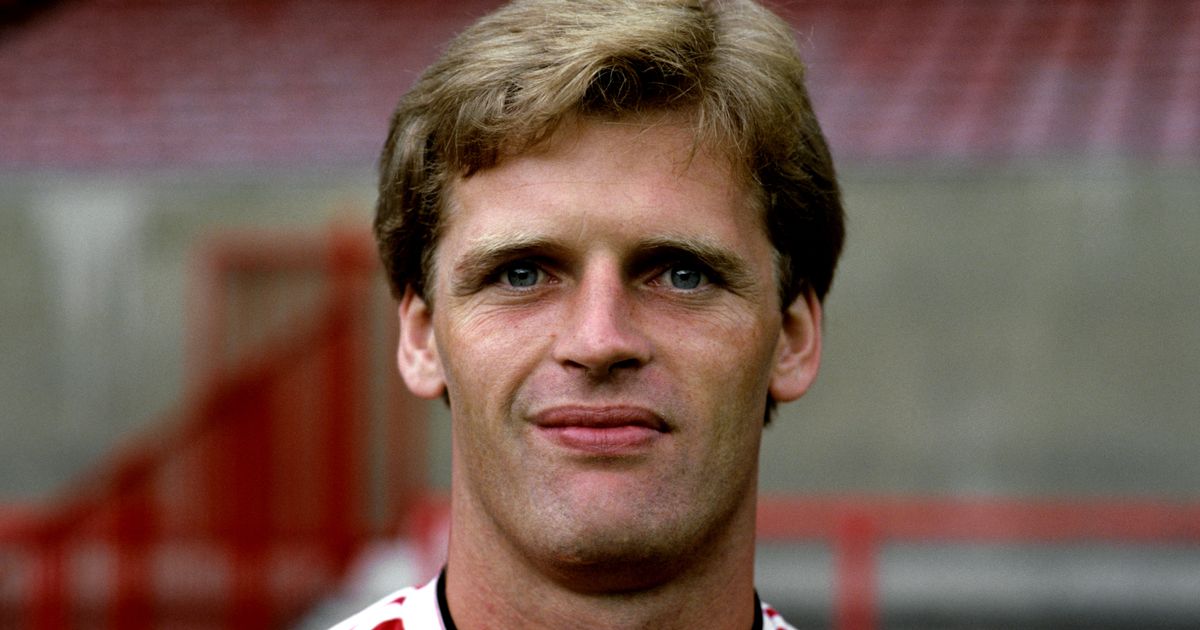
Gordon McQueen was diagnosed with vascular dementia and died in 2023 at the age of 70. Today’s inquest heard in a landmark judgment that the cause of death contributed to his death.
Former footballer Gordon McQueen’s brain showed signs of injury from a headed ball, which contributed to his death, an inquest heard today.
The Scotland legend died of pneumonia, vascular dementia and chronic traumatic encephalopathy, known as CTE, which the coroner said was related to heading the ball.
Football greats Bryan Robson, Gary Bailey, Lou Macari and Joe Jordan gave evidence that McQueen was consistently asked to head the ball in both defensive and attacking situations during training.
Professor Willie Stewart, a consultant at Glasgow’s Queen Elizabeth University Hospital who examined McQueen’s brain after his death, said CTE was present.
read more: Marseille manager asks his mother for advice on Mason Greenwood’s transferread more: Mikel Arteta slams Arsenal star for ‘sulky reaction’ after disgruntled departure
Join us on Facebook! For the latest news, analysis and more on Mirror Football’s Facebook page
North Yorkshire’s senior coroner Jonathan Heath ruled that a post-mortem examination found evidence of damage caused by heading during his career.
“A post-mortem examination confirmed the presence of CTE. The cause of death was pneumonia in the lower lungs, probably as a result of vascular dementia,” he said in his ruling.
“It is also likely that the impact of heading the ball contributed to his CTE. This condition needs to be considered as a contributing factor to his death.”
The conclusion was that McQueen died of pneumonia, vascular dementia, and CTE.
In a statement after the autopsy, the McQueen family said Gordon did not simply die from CTE, but had lived with it.
“Gordon loved football, but the last years of his life were incredibly difficult,” his family said.
Experts increasingly warn that CTE begins in childhood, progresses quietly over many years, and is not limited to elite football, but can affect players anywhere from grassroots to the professional game, where repeated impacts to the head occur.

Hayley McQueen, daughter of Scottish legend Gordon (Image: Daily Record)

Gordon McQueen and daughter Hayley (Image: Daily Record)
Head Safe Football, a registered charity dedicated to player welfare, said McQueen’s inquest should be a catalyst for meaningful change.
“Gordon’s story shows why football must take action to protect its future,” said Dr. Judith Gates, Chairman and Co-Founder of Head Safe Football.
“Living with CTE is devastating for both the affected athlete and their family.
“Exposure starts early and accumulates over time, so heading reduction should start with young players and then be applied to all levels.
“The message from Head Safe Football is simple: Think head safe. Reduce heading in training.”
Manchester United and Scotland legend McQueen was diagnosed with vascular dementia and died in 2023 at the age of 70.
Evidence heard earlier this month showed his daughter Hayley McQueen, a Sky Sports presenter, was asked whether she thought her father got sick because of football.
She told the hearing in Northallerton, North Yorkshire: “He goes, ‘Yeah, all those years of being head of football probably didn’t help.’ I remember coming home from school and my dad was in bed, or lying down.”
“He said his head hurt. I remember thinking, ‘Why does my head hurt?'” McQueen made around 350 appearances for St Mirren, Leeds and United between 1970 and 1985.
Mr Haley told the inquest he had no recollection of any head injuries during his career, apart from a few concussions.

Gordon McQueen was a towering defender (Image: Popperfoto via Getty Images)
But she explained how loved ones noticed a change in his personality shortly after his 60th birthday. He had trouble swallowing, which “continued for years,” Haley said.
“His balance was very, very off and his personality started changing. My dad was very outgoing and part of the dinner and after-dinner circuit. He turned off, and that wasn’t my dad.”
Mr McQueen had also been diagnosed with throat cancer, but a dysphagia caused him to have trouble swallowing. “He had no idea what year it was or what day it was,” Haley added.
“He was very active, doing crosswords, trying to watch football. He lost the ability to write. He couldn’t make tea. He was confused about what went where. He kept saying, ‘There’s something wrong in my head.’ He was often confused about things. He was never human. He had an incredible memory for the past.
“Rather, my father was a shy person. He would be the center of attention, but he had to be asked questions to speak.”
Michael Rawlinson KC, speaking on behalf of the McQueen family, asked how his father scored his goals.
She answered, “Mainly with my head from set pieces.” They spoke to Dawn Astle, the daughter of former England striker Geoff Astle, whose mother Yvonne suffered from a brain disease called chronic traumatic encephalopathy (CTE) and who died in 2002 at the age of 59, to find out more about his illness.
Professor Stewart, a consultant at Glasgow’s Queen Elizabeth University Hospital who examined McQueen’s brain after his death, said CTE was present.
“Gordon technically fell into a lower stage of the disease, although he was on the threshold of a higher stage,” he added.
Professor Stewart said the symptoms of CTE are cognitive decline and neurobehavioral changes that “cannot be explained by other symptoms”.
He said the symptoms were “typical of professional soccer and rugby players with long careers.” When asked if there is a causal relationship between CTE and repetitive head trauma, he said, “The answer is yes.”
Mr Heath said an autopsy revealed pneumonia, mixed vascular dementia and CTE in McQueen’s right lung.
Professor Stewart, who carried out a 2021 study into whether certain positions on the pitch were more associated with neurodegenerative diseases than others, said: “Non-ball headers and goalkeepers had a similar risk to the general population, but outfield positions, especially defenders, had a higher risk.”
The English and Scottish Football Associations and Manchester United were all represented at the inquest.
Join our new WhatsApp community and receive Mirror Football content every day. Community members also receive special offers, promotions, and advertisements from us and our partners. If you don’t like our community, you can always check out. If you are interested, please read our privacy notice.
Sky Sports Premier League and EFL package discounts

£49
£35
sky
Get the deal here
Sky has reduced the price of its Essential TV and Sky Sports bundle ahead of the 2025/26 season, saving members £336 on their bill and offering more than 1,400 live matches from Premier League, EFL and more.
Sky will broadcast at least 215 live Premier League matches next season, with an increase of up to 100 more.
