

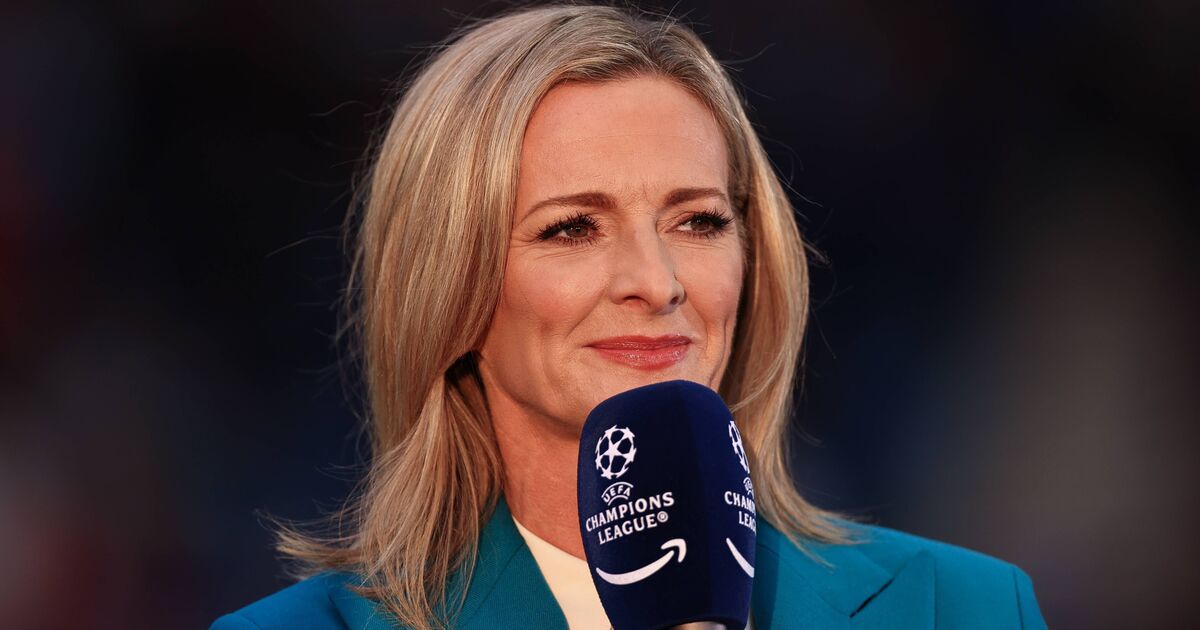
Gabby Logan is leading Amazon Prime’s coverage of Champions League matches this season. The broadcaster took on her latest assignment during what is already proving to be an exciting period, working alongside Gael Clichy, Theo Walcott and Clarence Seedorf for Arsenal’s game against Atletico Madrid at the Emirates Stadium on Tuesday night.
After being appointed to replace Gary Lineker on Match of the Day alongside Kerry Cates and Mark Chapman, Rogan has been mostly on TV lately, having also fronted the BBC’s Women’s Rugby World Cup and UEFA Women’s Euro. Regarded as one of the most known, loved, and highly regarded sports presenters in the industry, the 52-year-old’s professional trajectory continues to grow, but this doesn’t mean her rise has been without obstacles.
Rogan secured her first job at Sky Sports at the age of 23 and spoke openly about the sexism she faced in her early days on the air.
In her memoir, The First Half, she confessed that although she could not say she experienced discrimination, she was “frequently subjected to comments and scenarios” that she would not have encountered with her male counterparts.
Looking back at the beginning of her career, she recalled shocking statements made by “famous” presenters during her tenure at Sky. She initially decided to ignore it, but later confessed that it “almost killed me inside.”
“Sky Sports was a tough school, but it’s hard to say I was discriminated against,” she wrote. “I was there first because they wanted to get more women on screen, and there was a positive vibe to it.
“I sometimes got on the butt of comments and scenarios that my male colleagues might not have had to put up with. One afternoon, as I was wandering around the office, a well-known male presenter shouted: ‘Hey, Jolas! (her maiden name). How many Premier League footballers have you put up on your bedpost?’
“At 23 years old, I didn’t have the verbal fortitude to knock him out with a witty retort. His entire entourage chuckled. I smiled and kept walking. I was dying inside.”
Unfortunately, this wasn’t the only inappropriate comment directed at the Six Nations presenter in her early days on the air, as she further revealed: “An older rugby league presenter stopped me in the hallway one day and said: ‘You’re a great player now, but unfortunately for you, that’s one of those players who’s going to be on his knees when he’s 30.’
“‘Well, if you’re still around when I’m 30, maybe you’ll understand.’ That was the best I could do.”
Despite his experiences, Logan stressed in his memoir that sports broadcasting was not a “cesspit,” and given the prevailing attitudes in society at the time, he would have expected similar comments to be leveled at him no matter what industry he worked in. “Let me be clear: while the world and society revolved around goodness, sports television was not filth,” she wrote.
“If I had worked at a top law firm or as a trader at an investment bank in the mid-to-late 90s, I think I would have seen and heard the same ridiculous and sexist material.
“It was very much a male ego-driven environment. I think there were quite a few men there who felt there was a little too much of an alpha vibe to it. It was also male-dominated behind the camera. Ninety percent of the cameramen, sound technicians, statisticians, directors and producers were men.”
“It’s like turning a tanker around, right?” she added, talking about the shift in mindset within her profession. “At first the movement is very slow and it feels like nothing is changing, but you have to keep going and eventually the whole boat will follow and you will gain momentum.
“My commitment to being there, doing my job, and being visible and good was more powerful than anything I could do to accelerate change.”
