

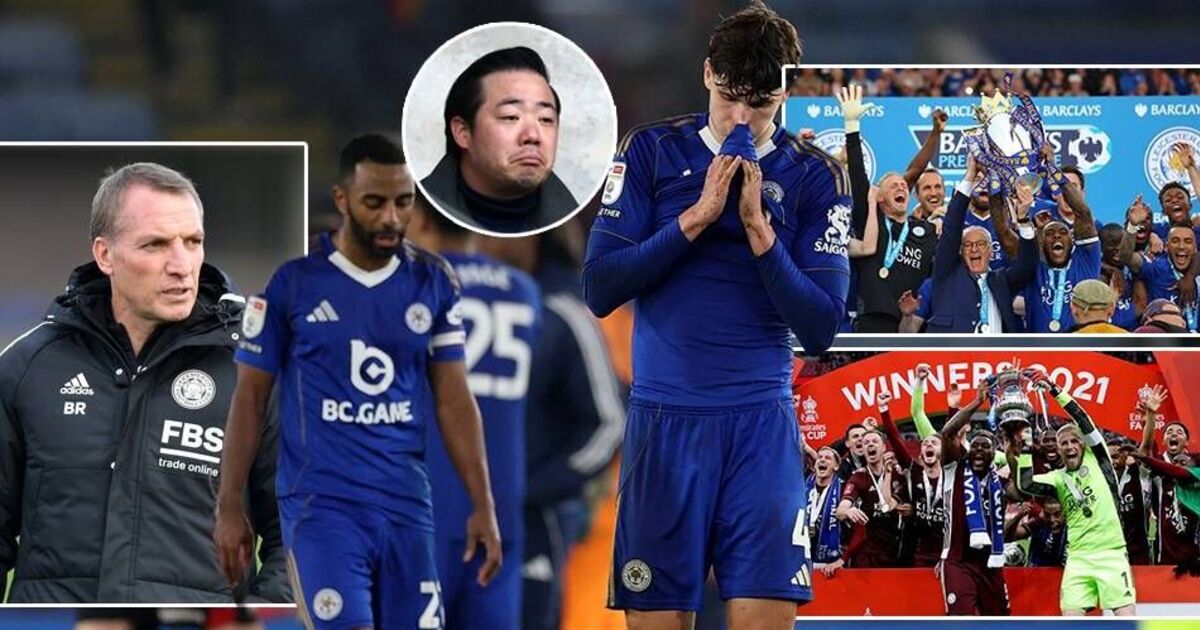

Leicester won the Premier League exactly 10 years ago. (Image: Getty Images)
“If you think Leicester can get into League One, you’re out of your mind,” were the words of midfielder Jordan James in December when asked about the possibility of Leicester City facing consecutive relegations. And it’s easy to kind of understand where the Welsh midfielder is coming from. This is the same club that lifted the Premier League trophy exactly 10 years ago under manager Claudio Ranieri.
Just five years ago, the club won the FA Cup for the first time in their history under manager Brendan Rodgers. This is a club that has given others license to dream. That dream quickly turned into a nightmare. After a dreadful campaign they slipped into League One and a draw with Hull City officially sealed their fate. Leicester are now a cautionary tale about how not to run a football club.
In fact, alarm bells started ringing all the way back in 2020, when the Midlands outfit collapsed late in the season, narrowly missing out on Champions League qualification and the hefty financial rewards that came with it.
This lack of income has been exacerbated by the coronavirus pandemic, which has dealt a major blow to the Foxes’ Thai ownership. Leicester again performed dismally the following season, but the board remained steadfast in their dedication to Rodgers.
That glorious moment against Chelsea under the arches at Wembley will remain in the memory for a long time. But the club’s disastrous decline since then will undoubtedly be an even more lasting legacy. During the disastrous summer transfer window of 2021, the club spent huge amounts of money on Patson Daka, Boubakary Soumare and Jannik Westergaard, but without releasing any of their key players to make ends meet. Leicester is feeling the economic impact of that ill-fated venture to this day.
The 4-1 defeat of local rivals Nottingham Forest in the FA Cup in February 2022 stands out as the decisive moment when the foundations of the King Power’s ownership began to crumble. Rodgers was put in charge and warned the team needed a “refresh”, while also insisting Leicester were “not the same club” just a few months later.
The departures of title-winning heroes Wes Morgan, Christian Fuchs and Kasper Schmeichel caused an alarming drop in standards, and the deterioration has only worsened since then.
The Foxes officially withdrew from the Premier League the following season, with Rodgers sacked at the end of the season and replaced by Dean Smith, although many would argue that this decision came too late. Relegation is bound to happen, but it definitely happened to a team as talented as Leicester.
Express sports on FB! Get all the best sports news and more on our Facebook page
There should have been a thorough investigation into how the club got into such a predicament, especially given its once strong position. Such a review was indeed promised by the club’s ownership, with owner Ayawat Srivaddhanaprabha admitting an “internal review” that never materialized.
All club leaders, including widely criticized director of football John Rudkin, stood their ground as if nothing had happened. Leicester should have heeded the red flags. They simply didn’t.

Leicester City will continue to play in League One next season. (Image: Getty Images)
However, there was a glimmer of hope as the Foxes secured an immediate return to the Premier League under manager Enzo Maresca during the 2023/24 season. Even that winning season was overshadowed afterwards and ultimately proved to be hugely damaging for Leicester in the long run.
The club spent heavily to secure promotion, signing players such as England internationals Harry Winks and Conor Coady in big deals worth around £18 million.
World Cup Legends: The stars of soccer’s biggest tournament in history – buy the special edition now
This meant Leicester were once again in breach of the EFL’s PSR regulations. They have previously escaped punishment for post-relegation technicalities, but they weren’t so lucky this time (but more on that later).
Leicester repeated the same grave mistake after returning to the top flight. Maresca left for Chelsea, with former Forest manager Steve Cooper appointed as his successor. His appointment was a mistake from the start, with some players openly revealing their fondness for former manager Maresca in a Copenhagen nightclub shortly after his arrival.
The signings of Oliver Skip, Jordan Ayew, Bobby de Cordova-Reid and Caleb Okoli did little to inspire confidence that this was a team capable of surviving in the top flight. Cooper was ultimately sacked in November, paving the way for Ruud van Nistelrooy to take over.
The Dutchman’s tenure couldn’t have been more disastrous, as he lost 18 of his 25 Premier League games and suffered relegation. It was confirmed that Leicester’s drop two seasons ago was not an anomaly, but rather a symptom of a deeper problem.
It was equally clear that the former Manchester United striker had no long-term future at the King Power Stadium, but it was not until June 27, more than four weeks after the final game of the season, that Van Nistelrooy was formally relieved of his post.
A further three weeks passed before the appointment of his successor, Marti Sifuentes, was decided, but the postponement occurred 26 days before the start of the season, leading to club legend Jamie Vardy’s departure without a suitable replacement in place, greatly disrupting the club’s pre-season arrangements.
Despite a promising start, Cifuentes was once again a disappointing choice, winning just 10 league games before being sacked in January. Leicester then took almost a month to identify his replacement, Gary Rowett.
During this period, Leicester suffered three consecutive defeats, including a 4-3 defeat in which they surrendered a three-goal advantage to Southampton.
This result, along with the previous six-point deduction for a PSR violation, seemed to have caused irreparable damage to the dressing room, with points confirmed for the first time in the club’s history. The appeal was rejected by an independent panel and Leicester fell into a relegation scrap.
However, those who believe that off-field governance was the main reason they dropped to the third division are making a grave mistake. Rowett appears unfazed by the club’s predicament, having suffered the same fate as many of his predecessors, failing to extract performance from the squad he has assembled at great expense.
The former Millwall manager has been in such good form that Leicester have slipped into League One for only the second time in their history, with just one win. Even if no points were deducted, Leicester would remain in the relegation zone and under real threat of being relegated to the third division.
Anyone who claims Leicester don’t deserve to be in League One has lost their mind, given the trajectory the club has been on for some time.
