

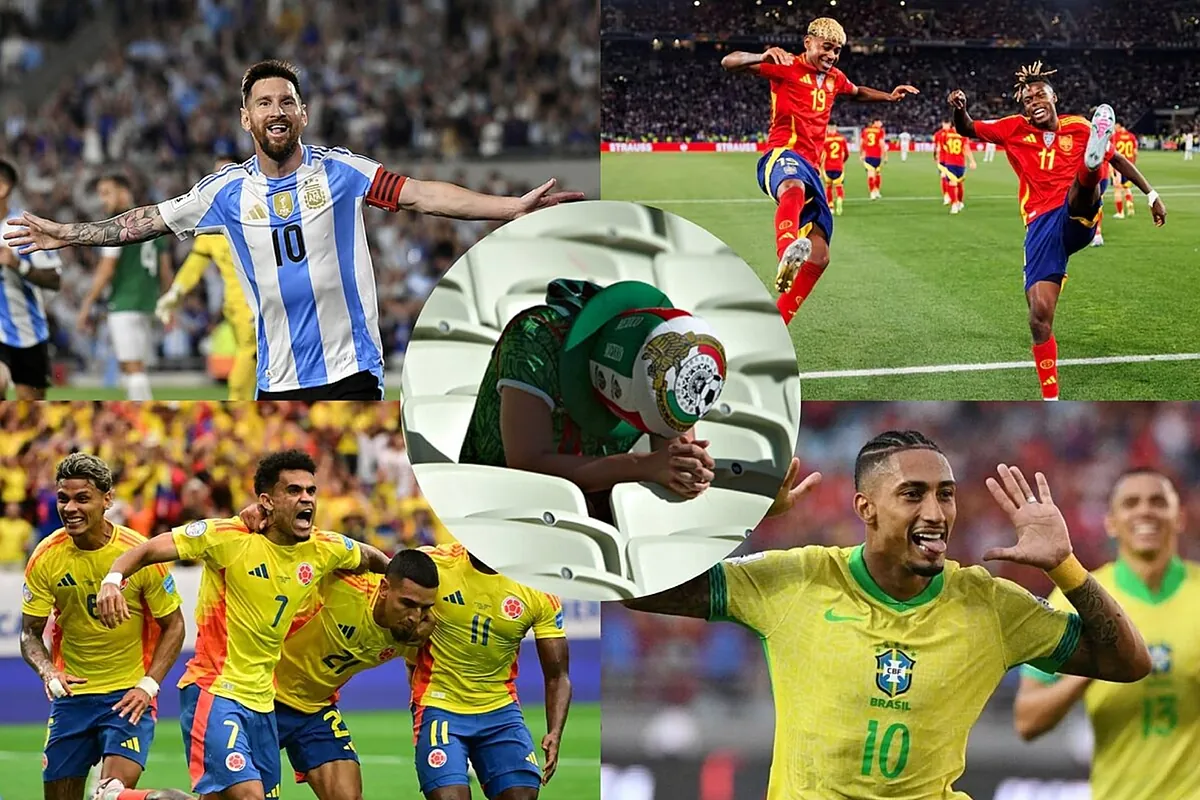
a A month before the official draw for the 2026 World Cup, scheduled for Dec. 5 in Washington, D.C., artificial intelligence simulations have begun to spark discussion about the possibility of a new format of 48 teams in 12 groups. The model projected everything from the group stage to the final, presenting an impressive picture for the host nation.
According to the exercise, Mexico, the United States and Canada will all advance through the group stage, but none will advance past the round of 16. Mexico lost to Brazil 3-2, the United States lost 2-1 to Argentina in overtime, and Canada would be eliminated in the Round of 32 by Argentina. Despite the home momentum, AI does not predict heavy losses for the three tournament hosts.
White House video confirms position on Messi vs. Cristiano Ronaldo ‘GOAT’ debate
Argentina and Spain, big winners
The simulation predicts outstanding performances from Argentina and Spain, with these teams going through all the knockout stages before meeting in the final scheduled for New York’s MetLife Stadium. The model takes into account Lionel Messi’s presence in 2026 and argues that his leadership and hierarchy will be crucial for a team that features a new generation of attackers.
In Spain’s case, the predictions are that they will be the dominant team in terms of possession and can beat England in the quarter-finals and Colombia in the semi-finals. However, the AI predicts that Argentina will be more efficient in attack in the final.
Argentina’s double championship and a powerful country with a complicated path
This scenario ends with Argentina defeating Spain 2-1 and winning their second consecutive World Cup. La Albiceleste also defeated Brazil in the semi-finals after a 2-2 draw and a penalty shootout victory. According to the simulation, Brazil will reach this stage after defeating France in a high-level quarterfinal match.
Meanwhile, Spain will advance to the finals by defeating Colombia 3-1, a South American team whose model has shown a solid performance up until it faces a European team.
The practice also showed consistent performances from Germany, England and Portugal, although they were not strong enough to advance to the finals.
Expectations for the match against Mexico and the real draw on December 5th
Although this is just a simulation, the results have reignited the debate about Mexico’s potential for 2026. The AI suggests a shortcut, but a draw will determine whether El Tri faces an accessible group or a more complex scenario.
FIFA defines groups into four pots based on world rankings. Three countries have already qualified: host Mexico, the United States, and Canada, and their rankings will be determined according to the tournament schedule. Additionally, this format also allows for a third-place finish, opening up new combination possibilities in an unprecedented World Cup.
