

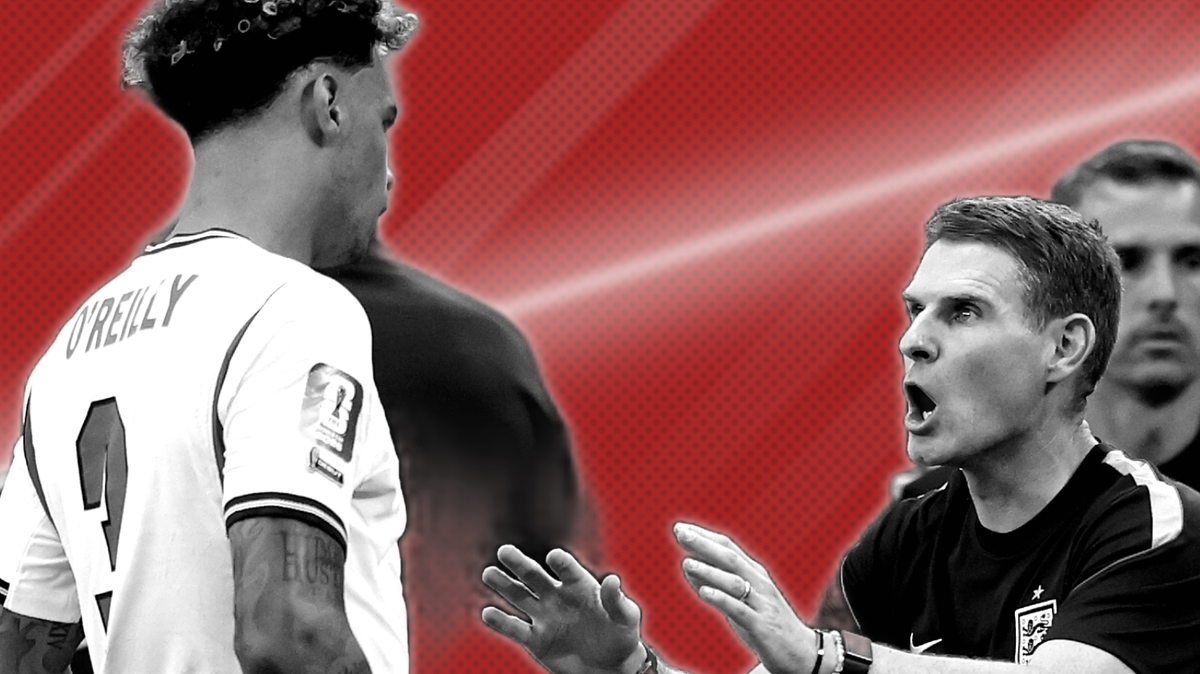
England were in the mood to exorcise their demons with an aggressive attacking performance against one of their most feared opponents of the past 20 years in Croatia last night, winning their opening Group L game 4-2.
The results, and most of the performances, were very enjoyable. Four goals, three points and a newfound confidence to play on the front foot, something never seen before for an England team at the World Cup.
But listening to Anthony Barry’s half-time interview on ITV, you could be forgiven for thinking England were trailing at half-time, rather than tied at 2-2.
Thomas Tuchel’s assistant manager described the team’s opening 45 games as “complicated and confusing”, complaining of “nervous” energy, poor decision-making and an inability to play with the freedom they desired.
ITV critic Gary Neville said Barry was “completely pissed off”.
Within seconds of the restart, Jude Bellingham’s goal put them back in the lead, but a late goal from Marcus Rashford erased any doubts of an outcome other than England’s victory.
But when we look at the data at Machine Football, we find that Barry’s assessment of the first half is surprisingly accurate. Here we break down what England must improve to reach the World Cup.
“Quite a lot of nervous energy early on.”

ARLINGTON, TEXAS – JUNE 17: England assistant manager Anthony Barry speaks with England number three Nico O’Reilly during the 2026 FIFA World Cup Group L match between England and Croatia at Dallas Stadium in Arlington, Texas on June 17, 2026. (Photo by Eddie Keogh – The FA/The FA via Getty Images)(Image: Getty)
One of Barry’s most striking observations focused on England’s decision-making.
“We made some decisions in a situation where the energy was not free in our minds,” Barry said. “Play long when you should play short, play short when you should play long.”
This problem did not necessarily appear in the first stages of play from the back. Between them, Ezri Konsa and John Stones completed 131 passes with an accuracy of over 94%. However, there were some loose passes that caused unnecessary pressure in central areas.
Instead, England’s forwards struggled to get involved in possession. Harry Kane completed 17 passes with 71% accuracy, while Bellingham completed just 23 passes in 85 minutes, both well below the averages of Bayern Munich and Real Madrid this season.
Anthony Gordon completed just nine passes in 78 minutes, compared to an average of 26.3 per game for Newcastle, while Noni Madueke completed 16 passes compared to his Premier League average of 30.3.
The problem went beyond volume. England’s most creative players appeared reluctant to retain possession in their forward areas, with the result that the team often circulated the ball safely rather than gradually.
And Tuchel himself later told the media: “The decision we made was we chose to go safe and played too many balls backwards. We struggled to find our rhythm and we didn’t have the confidence to find our rhythm through the gaps with short passes.”
“I saw a statistic that 33 percent of ground games were won in the first half and 73 percent were won in the second half. So even off the ball, there wasn’t enough courage, there wasn’t enough dedication.”
There were moments when counter-pressing made up for this, such as when Madueke was fouled on a penalty and forced a corner kick that gave England the lead, but for much of the first half the pattern of play that Tuchel was looking for simply didn’t exist.
Zero successful dribbles by starting winger
Despite having space behind the Croatian wing-backs, England were unable to exploit it effectively in the first half. Maduke won a penalty and fired in an early cross to give Bellingham a golden opportunity to make it 1-0, but he lacked the direct running and dribbling that could have made the difference in the game.
The Arsenal man had zero successful dribbles in 78 minutes, while Gordon only attempted one dribble without success. In the Premier League, both players consistently rank among their team’s most attacking ball carriers, but that quality was lacking against Croatia.
Barry said England failed to “play through the gaps” and were unable to “accelerate the game the way we wanted”. The fact that England’s only moments of breaking their lines in the first half were from counter-pressing situations highlights how the team’s wingers avoided the type of individual behavior that could produce those moments from stable possession.

One of several moments when Madueke received the ball in space. England won a corner kick from the move, but the winger was unable to create an open play shooting chance (Image: BBC)
One notable example was when Bellingham played Maduke behind the Croatian defense 20 minutes later. Rather than drive towards goal, the winger delayed the attack and laid the ball to Reece James.
Instead of using dribbling or direct runs to extend the opponent’s lead, Croatia repeatedly had possession and allowed the opponent to reset.
set pieces to help
“We could always rely on set pieces,” Barry growled at half-time.
Both goals in the first half came from these situations – Kane’s superb header directly from a Declan Rice corner and his penalty on his second attempt after being fouled by Maduke from an early corner.
The underlying numbers reflect England’s clear threat from set-pieces and, based on the evidence presented here, could make the difference not just in this match but in many more.
Rice single-handedly converted all eight of England’s corner kicks, more than three times the set-piece specialist’s Premier League average for Arsenal, and created four chances that led to direct attempts on goal.
The quality of these shots was evident in the chances they created. Konsa has an expected goals (xG) of 0.91 from just two shots, a clear sign that England are under threat from dead-ball situations.

Rice’s attacking contribution has steadily increased in recent seasons, highlighting his growing importance in the final third and set-pieces for Arsenal and England (Image: Machine Football)
Croatia were able to contain most of England’s open play combinations in the first half, but struggled every time England entered the penalty area from a corner or free kick.
And while they struggled to consistently create chances with their central passing, stealing dead balls wasn’t an issue. While England were worried about possession, their set-piece structure consistently pointed the way home.
Clinical practice in Croatia causes confusion
Despite all the concerns Barry publicly highlighted, Croatia generated 0.70 xG overall. England, on the other hand, piled up 3.20.
Croatia were more clinical than consistently threatening. England’s first-half performance felt chaotic, not because Croatia repeatedly opened the scoring, but because of the way the game played out, with two goals quickly canceled out.
Barry’s half-time assessment may have sounded harsh in the context of a match that England would eventually win 4-2, but the data supports almost every concern he raised.
Neville praised Barry’s interview, saying it “said a lot about the mentality of how Thomas Tuchel would have fed into them at half-time”.
For a long period of the first half they were, as Barry said, nervous and hesitant, unable to play as freely as they usually do, but after the break they were able to mercifully take the game to the ground.
Tuchel added: “Even if the result doesn’t go our way, we want to play our way. I tried to encourage them to aim for that.”
Despite a mixed start, England’s first win was convincing and well-deserved.
But winning teams always find ways to improve, and their response to legitimate criticism should encourage that this team has the character to do just that.
Sign up now for the Make Football Great Again newsletter and get the latest World Cup news straight to your inbox!
Join our new WhatsApp community and receive Mirror Football content every day. Community members also receive special offers, promotions, and advertisements from us and our partners. If you don’t like our community, you can check it out whenever you like. If you are interested, please read our privacy notice.
Upgrade your World Cup TV setup with Sky Glass ‘designed for soccer’

From £4.50
sky
Get the deal here
Sky is marking the start of the 2026 FIFA World Cup by reducing prices by 20% on its entire range of glass TVs. Until June 17, shoppers can upgrade to a Sky smart TV ‘designed for football’ from £4.50 a month when taken with a Sky TV and Netflix package.
