

If you’ve had a passing interest in this summer’s World Cup, you’ve probably seen Gianni Infantino. You really can’t miss him. The FIFA president was almost everywhere.
No matter where the 104 match was being played, the bald head of the head of football’s governing body was there, seemingly beaming at us from outside the television set.
In fact, Infantino personally managed to watch 44 matches, from the World Cup opener on June 11th to the final between Spain and Argentina on July 19th. This is more than one match a day, even though the World Cup was held in 16 cities across three countries.
Logically speaking, this was a great achievement, and his efforts were rewarded with regular airtime thanks to an agreement with the host broadcasting service (49 percent owned by FIFA) that meant a “majestic shot” was mandatory in each half. The 56-year-old wanted to be a central figure in the biggest World Cup in history, achieving a personal goal and successfully visiting all the host cities.
Infantino wanted to network. He wanted to rub shoulders with US President Donald Trump, Saudi Public Investment Fund President Yasir al-Rumayyan, and countless world leaders and heads of FIFA affiliates.
His efforts have helped strengthen his grip on FIFA, with the Guardian reporting that Mr Infantino has received formal support from more than 200 members for re-election as president. Even the scandal in which President Trump intervened in FIFA’s procedures to overturn the red card of American striker Folarin Balogun did not diminish Infantino’s status.
But the way Mr. Infantino accomplished all this, along with President Trump’s reported support for him to become the next UN Secretary-General, casts a long shadow over this entire farce. It’s a private jet sponsored by Qatar Airways.
Flight data shows Infantino flew his private Gulfstream G650 106,323 km (66,066 miles) during the World Cup, almost three times the circumference of the Earth, burning 1,020.3 tonnes of CO₂e in the process.

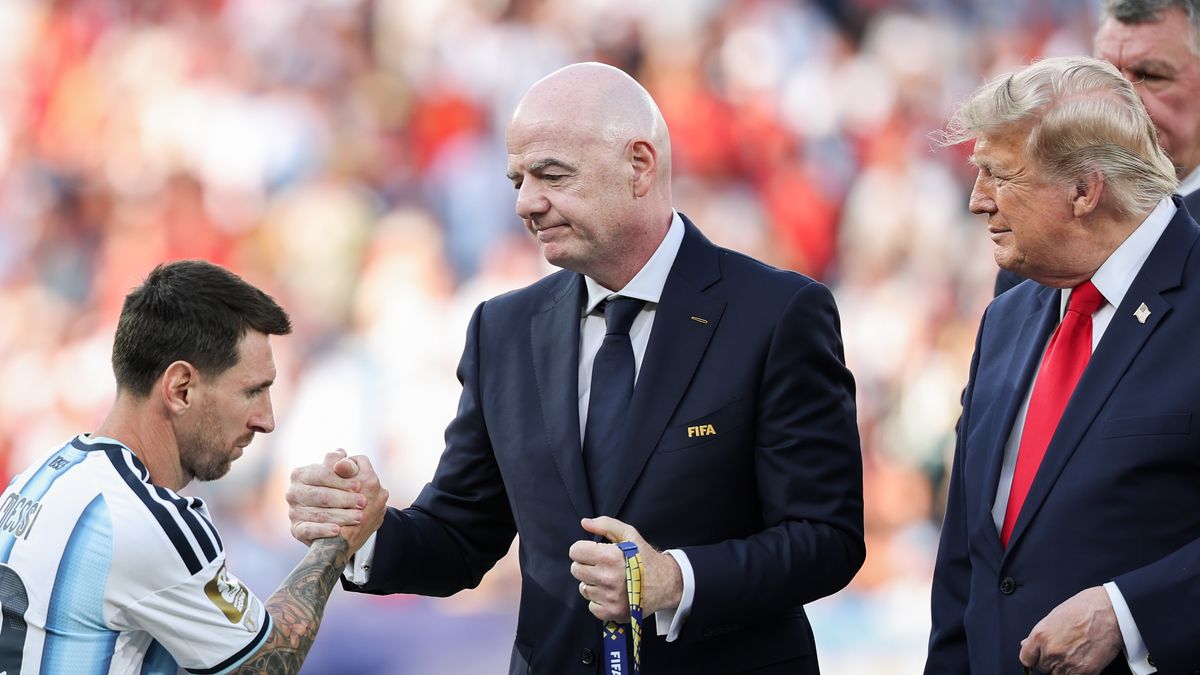
Gianni Infantino used the World Cup as a networking event (Image: Eva Marie Uzcategui/FIFA via Getty Images)
FIFA’s decision to expand the tournament to 48 teams and spread it across three countries suddenly makes it the most polluting World Cup in history, with projected emissions of 9 million tonnes of carbon dioxide equivalent (MtCO2e), almost double the historical average for previous tournaments from 2010 to 2022. The majority of emissions come from aviation.
FIFA has pledged to cut greenhouse gas emissions by 50% by 2030 and to net zero by 2040, and Infantino vowed to leave a “positive footprint” in North America. Activists believe his actions speak louder than words.
“Infantino’s Qatari private jet transported him from VIP box to VIP box throughout the bloated tournament as players and supporters braved the intense heat,” Fossil Free Football founder Frank Huisin said. “Nothing more perfectly illustrates FIFA’s willful blindness to the threat of climate change facing football and its fans.”

Gianni Infantino (photographed in 2017) regularly travels on an executive jet in Qatar (Image: ISAAC KASAMANI/AFP, Getty Images)
Katie Cross, chief executive of sports sustainability charity Pledgeball, said: “Against the backdrop of a heatwave, bushfires and expensive World Cup fans, the incredible emissions generated by Infantino’s use of a private jet shows a complete disregard for the length of the match, the players and fans who attend it.”
Andrew Sims, director of the New Weather Institute, said it left a “cloud of disdain” on Infantino’s jets, while Freddie Daly of the Cool Down Sports for Climate Action Network said it was “further evidence that he and FIFA cannot be trusted to protect the game from the worsening climate crisis”.
Jenny Ammann, a postdoctoral researcher at Loughborough University, has been interviewing fans about the relationship between climate change and football, and has consistently heard negative reviews of FIFA presidents.

Gianni Infantino was able to shake many hands at a huge environmental cost (Image: Robbie Jay Barratt – AMA/Getty Images)
“I cannot recall a single interview in which Infantino’s actions and decisions were not criticized,” she said. “Fans have consistently described his approach as ridiculous and hypocritical, and have expressed frustration that international football and its leaders are being called to adopt more climate-friendly behavior, while continuing to operate in a manner completely disconnected from the wider social crisis we face.
“Infantino’s travel choices for this tournament will generate emissions hundreds of times more than the average European soccer fan emits in a year. Actions like this do nothing to encourage more sustainable behavior among fans and suggest that neither Infantino nor FIFA intend to lead by example.”
There is disbelief behind the scenes at FIFA over criticism of Infantino, with a common defense being that he could not have just watched the tournament from his office in Miami. Infantino wants to present himself as a contrast to UEFA president Alexander Ceferin, who was criticized for playing only two games at the Women’s Euros last summer.
When asked about Infantinio’s use of a private jet and the environmental concerns it raised, a FIFA spokesperson said: “As we have consistently stated, FIFA has introduced regulations establishing a framework for the flight and travel of FIFA personnel. The FIFA President routinely travels with relevant staff on business and tournament-related matters and strives to visit FIFA member associations whenever possible.”
“Travel may be arranged by commercial airlines (including low-cost carriers) or by private charter, depending on which is more efficient and cost-effective in the circumstances. FIFA will pay the travel expenses.”
