

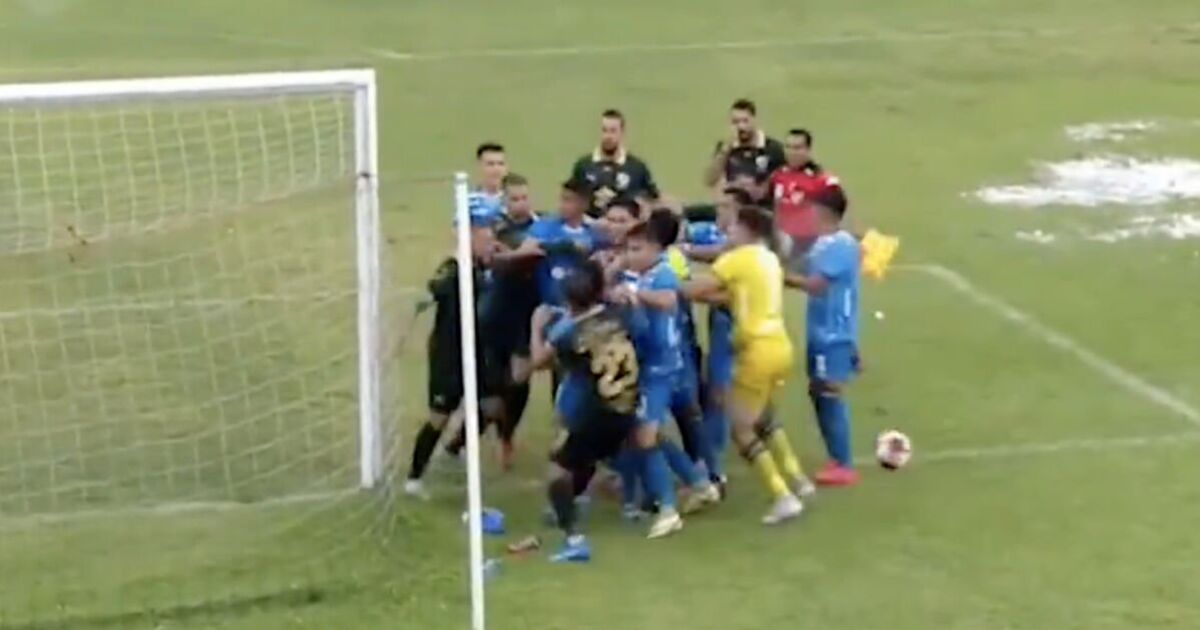
During a tense match in Bolivia, seven players were sent off, eight were given yellow cards, and police intervened in a large brawl and had to use tear gas after a second fistfight. Five soccer players were given their marching orders after a scuffle broke out on the pitch at the end of the first half of Blooming’s game against Bolivar.
And the match officially became one of the most red-carded matches in South American top-flight football, as two more were sent off in the second half after the game restarted with just 17 players. Troubles erupted six minutes into the first half when Blooming goalkeeper Braulio Uraezana hurriedly reprimanded rival Damian Batalani after the Argentine winger collided with the latter as he was aiming for the same ball.
Batalani’s teammates looked at things differently, called for a penalty and went to help Batalani, who was struggling on the ground in one of the puddles that covered the pitch after heavy rain.
The ensuing scuffle saw players from both groups kicking, shoving and punching each other, including goalkeeper Blooming, who was knocked to the ground before getting back to his feet and punching his rival.
Police officers who were part of the crowd control operation had to run to the finish line area where a large scuffle broke out to restore peace.
Blooming, who had four players receive red cards and only seven players remained on the pitch by the final whistle, lost 2-1 against Bolivar, where three players were sent off. The away team scored the winning goal in the third minute of extra time.
Violence continued in the locker room after the final whistle, and police had to use tear gas to restore order. The post-match press conference was canceled.
Surprisingly, the Bolivian press today pointed out that Saturday’s match was not the worst for the most prolific Reds players in the country’s football history – the record being the eighth in 1999, when Blooming defeated The Strongest 2-0.
The Bolivian Football Federation later confirmed that it was considering sanctions against both teams. Bolívar goalkeeper Carlos Lampe, who also plays for the Bolivia national team, said:
“That can’t happen. They hit our goalie coach and there was a fight. There wasn’t enough security. The two locker rooms were very close together.”
Teammate Daniel Catano, who received a red card, told the referee after the match: “There was a scuffle, there was some pushing and shoving, but I didn’t hit any of my opponents.
“The referee was caught up in the emotions of the moment and didn’t know how to handle the game. As a result, the game was played in an absurd way. So many players were sent off, something that hasn’t happened in a long time in the world of football.”
An appalled Bolivian soccer fan responded on social media: “This kind of thing makes our soccer the worst in South America.”
The most red cards in a Premier League match is three, but that has happened several times. Seven weeks ago, during a match in Colombia, a referee was slapped in the face after sending off a player.
The incident occurred during the match between Deportivo Quique and Real Alianza at the Cerro Castro Stadium in Aracataca.
In the 66th minute of the match, Vanessa Ceballos approached the substitute bench and gave Real Alianza’s Javier Bolivar a red card for unsportsmanlike conduct.
After Ceballos was given a red card, Bolivar got up from the bench and confronted the female referee. He then raised his right hand and slapped her on the mouth before pulling away.
Bolivar apologized for his actions in a subsequent statement, but appeared to deny that he had intentionally assaulted anyone, saying he was only trying to take the whistle out of the referee’s mouth.
Surprisingly, the Bolivian press today pointed out that Saturday’s match was not the worst for the most prolific Reds players in the country’s football history – the record being the eighth in 1999, when Blooming defeated The Strongest 2-0.
