

GUADALJARA, Mexico (AP) — When it comes to formations, it’s a very tough time in terms of numbers. world cup.
Every team starts with a goalie in front of the net, but it’s then up to the 48 coaches to optimize their players and adjust their lineups to effectively match up with their opponents.
On paper, a list might look like an area code, phone number, or lottery combination (4-4-2, 5-3-2, 4-2-3-1, etc.).
But it all depends on how the coach sets up his 10 field players, with some coaches focusing on attack, others on containing tough opponents, and still others trying to capitalize on the talents of their star players.
Managers tend to have a preferred formation, but it is not uncommon for them to change formations depending on the opponent, or even during the match, in order to secure a lead or reverse a deficit. Coaches often start games with one scheme and end games with another.
According to FIFA’s match report, here are the nine formations used in the opening match of World Cup group play and what they mean.
Traditional (4-4-2)
4 defenders, 4 midfielders, 2 forwards.
It was used by 12 of the 48 teams participating in the first 24 matches of the World Cup. However, there were only two wins, Scotland vs. Haiti and Ivory Coast vs. Ecuador. It also coincided with the 3-4-3 scheme that produced the most losses, with 4.
Teams like Brazil, Uruguay and co-host Canada had adopted formations that theoretically promoted a balanced team, with an emphasis on solid defense by keeping lines compact.
This was a traditional formation for the last few decades, along with 4-3-3 and 5-3-2, until coaches started experimenting with bolder alternatives.
Attacking midfield (4-2-3-1)
4 defenders, 2 defensive midfielders, 3 attacking midfielders and 1 striker.
This formation has become common in modern football, with two holding midfielders guarding the last line, and three more attacking players responsible for the transition to the central striker.
Ten teams have used this design so far, with the United States, Great Britain, France and Austria winning matches.
High attack power (4-1-2-3)
4 defenders, 1 defensive midfielder, 2 midfielders, and 3 forwards.
This formation and 4-2-3-1 won the most games, four times each.
In a slight change from the above, one more player will be added to the attack phase. Mexico, Norway, Ghana, and Colombia used it to win their opening games.
Eight teams adopted this scheme, placing two wingers and a central striker in front of a three-piece midfield. It is a more attacking formation with only one defensive midfielder.
Title contenders Spain and the Netherlands also used this formation.
Solid midfield (3-4-3)
3 central defenders, 4 midfielders, and 3 forwards.
Seven teams adopted formations that balanced offense and defense with a strong midfield.
Only two teams, South Korea and Germany, have won and have scored the most goals so far. They defeated Curacao 7-1.
Another veteran (4-3-3)
4 defenders, 3 midfielders, 3 forwards.
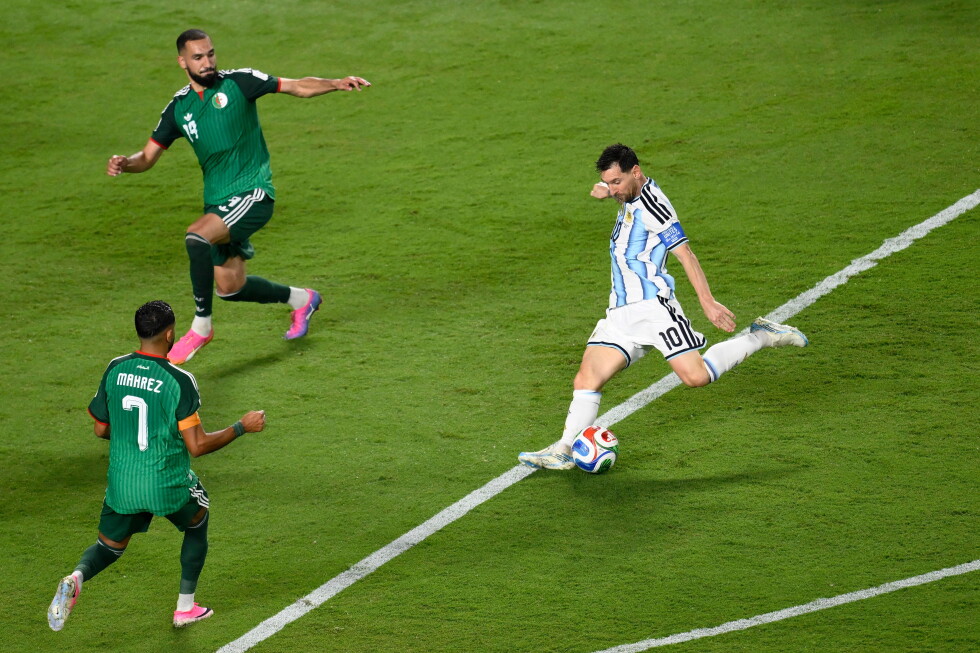
Lionel Messi’s Argentina were among the five teams to use this formation, helping Messi score three goals in a 3-0 victory over Algeria.
They were the only team to win with a traditional formation, with three midfielders feeding the forwards on either flank and the striker up front.
It was used by one of the most famous World Cup teams, the 1970 Brazilian national team led by Pele.
Argentina won the 2022 World Cup with that formation.
Attacking full-back (5-3-2)
5 defenders, 3 midfielders, 2 forwards.
There were no winners among the three teams that placed emphasis on the final line and adopted a formation in which the two fullbacks changed to wings during the attacking phase.
South Africa and Tunisia lost, but Congo’s surprising 1-1 draw against Cristiano Ronaldo and Portugal was good enough.
This has also been the traditional plan for decades.
Naked midfield (5-2-3)
5 defenders, 2 midfielders, 3 forwards.
Only the Czech Republic, who lost to South Korea, adopted a formation in which the two fullbacks moved up to the midfield depending on the situation of the game.
Defense-oriented (5-4-1)
5 defenders, 4 midfielders, 1 striker.
Australia won the match against Turkey using a defense-first formation with nine players between the back line and midfield.
Focus on transition (3-4-1-2)
3 central defenders, 4 midfielders, 1 attacking midfielder and 2 forwards.
Sweden used this formation in their 5-1 victory over Tunisia. The design is such that the attacking midfielder plays between the midfield and the forwards to facilitate the transition from defense to attack.
___
AP World Cup coverage: https://apnews.com/hub/fifa-world-cup
